This year we are going to put a different spin on the typical advent calendar. We are going to use books to countdown to Christmas!
The past few weeks I have been gathering together 24 Christmas stories I want to share with my kids this holiday season. I plan on wrapping each book individually. Starting on December 1st, we will choose one book to unwrap and read each day.
The only book that cannot be opened until December 24th is The the Night Before Christmas. It will be marked with "DO NOT OPEN UNTIL CHRISTMAS EVE".
Here is a list of the books we will be reading this season:
The Night Before Christmas by Clement C. Moore
Christmas Tree Board Book by DK
My First Christmas Board Book by DK
10 Trim-the Tree'ers by Janet Schulman
Christmas in the Manger by Nola Buck
The Spirit of Christmas by Nancy Tillman
The Night Henry Ford Met Santa by Carol Hagen
Santa Kid by James Patterson
Auntie Clause by Elise Primavera
Santa's Book of Names by David McPhail
There Was an Old Lady Who Swallowed Some Snow by Lucille Colandro
A Christmas Tree in the White House by Gary Hines
Merry UnChristmas by Mike Reiss
Olive, The Other Reindeer by J. Otto Seibold
Over the River and Through the Wood by Lydia Maria Child
Llama, Llama Holiday Drama by Anna Reudney
A New Improved Santa by Patricia Rae Wolff
How Santa Got His Job by Stephen Krensky
Polar Express by Chris Van Alsburg
A Orange for Frankie by Patrica Pollacco
Why I Love Christmas by Daniel Howarth
Bear Stays Up for Christmas by Karma Wilson
Snowmen at Christmas by Caralyn Buehner
Home for Christmas by Jan Brett
I am super excited to start this tradition with my kids. I plan on switching out a few books each year, but there are some on the above list that will always be in our advent calendar.
I know it is only November and we have not even made it to Thanksgiving yet, but I wanted to share this idea early in case you want to try it! It takes awhile to gather all the books!
What books would be on your top 24?

Saturday, November 5, 2011

Wednesday, October 26, 2011
Otis
My husband stumbled across the cutest book this weekend when we were at a local bookstore! Otis, by Loren Long, is a great story and I have a feeling it is going to be an instant classic.

Otis is a friendly little tractor who helps his farmer every day on the farm. Otis is a hard worker, but at the end of the day he likes to play! He loves leapfrogging bales of hay and rolling down the hills. One night as Otis is getting ready to go to sleep the farmer brings a new calf into the barn. The calf instantly takes to Otis and they become best friends! Then one day the farmer brings home a new yellow tractor. The farmer makes Otis sleep outside so the yellow tractor gets parked in the stall near the little calf. The little calf does not like the yellow tractor and misses Otis. On a hot summer day, the little calf wanders off to the mud pond to cool off. She ends up getting stuck. The yellow tractor tries to get her out of the mud pond, but its loud sound just scares the little calf and she sinks deeper and deeper. Otis hears that his little friend is in trouble and putts his way to the mud pond.
Will Otis be able to rescue his friend? You will have to read the story to find out!
This is a great book for building schema through text- to- self connections. Since this is a story about friendship children can easily make connections to their life. They can also make connections to wanting the newest toy on the market and forgetting about some of their old toys. This is also a great book to create inferences. The reader has to infer (use text clues and background knowledge) how Otis and the little calf feel. The reader can also make predictions as to what might happen next in the story!
Go grab this book and read it to your child. I know they will love it! If your child ends up wanting more Otis stories, do not worry there is another one: Otis and the Tornado.
Some questions to guide you thinking conversation:
1. Read to: "...the scared little calf drifted off to sleep" and ask your child: Can you think of a time when you were too scared to go to sleep? What helps you get to sleep when you are scared? What do you predict is going to happen next in the story?
2. Read to: "And the calf made the games of ring-around-the-rosy all the better" and ask your child: How do you think Otis and the calf feel about each other? Why do you think this?
3. Read to: "Then he moved the big yellow tractor into the stall next to the little calf" and ask your child: How do you think Otis feels? What do you think is going to happen to Otis?
4. Read to: " ...but she could not get him to play like the old days" and ask your child: Why do you think Otis does not want to play with the calf?
5. Read to: "The farmer was fit to be tied. Who could save the little calf" and ask your child: What do you predict is going to happen?
6. Read to: "...Otis putt puffed from around the barn and headed straight toward Mud Pond" and ask your child: What do you think Otis is going to do? Why do you think Otis decided to come and help?
7. Read to the end of the story. Ask your child: What lesson do you think the farmer learned? What lesson did this story teach you?
Enjoy reading this cute story with your child. If your kids are little like mine there is great news! Otis is available in a board book!

Otis is a friendly little tractor who helps his farmer every day on the farm. Otis is a hard worker, but at the end of the day he likes to play! He loves leapfrogging bales of hay and rolling down the hills. One night as Otis is getting ready to go to sleep the farmer brings a new calf into the barn. The calf instantly takes to Otis and they become best friends! Then one day the farmer brings home a new yellow tractor. The farmer makes Otis sleep outside so the yellow tractor gets parked in the stall near the little calf. The little calf does not like the yellow tractor and misses Otis. On a hot summer day, the little calf wanders off to the mud pond to cool off. She ends up getting stuck. The yellow tractor tries to get her out of the mud pond, but its loud sound just scares the little calf and she sinks deeper and deeper. Otis hears that his little friend is in trouble and putts his way to the mud pond.
Will Otis be able to rescue his friend? You will have to read the story to find out!
This is a great book for building schema through text- to- self connections. Since this is a story about friendship children can easily make connections to their life. They can also make connections to wanting the newest toy on the market and forgetting about some of their old toys. This is also a great book to create inferences. The reader has to infer (use text clues and background knowledge) how Otis and the little calf feel. The reader can also make predictions as to what might happen next in the story!
Go grab this book and read it to your child. I know they will love it! If your child ends up wanting more Otis stories, do not worry there is another one: Otis and the Tornado.
Some questions to guide you thinking conversation:
1. Read to: "...the scared little calf drifted off to sleep" and ask your child: Can you think of a time when you were too scared to go to sleep? What helps you get to sleep when you are scared? What do you predict is going to happen next in the story?
2. Read to: "And the calf made the games of ring-around-the-rosy all the better" and ask your child: How do you think Otis and the calf feel about each other? Why do you think this?
3. Read to: "Then he moved the big yellow tractor into the stall next to the little calf" and ask your child: How do you think Otis feels? What do you think is going to happen to Otis?
4. Read to: " ...but she could not get him to play like the old days" and ask your child: Why do you think Otis does not want to play with the calf?
5. Read to: "The farmer was fit to be tied. Who could save the little calf" and ask your child: What do you predict is going to happen?
6. Read to: "...Otis putt puffed from around the barn and headed straight toward Mud Pond" and ask your child: What do you think Otis is going to do? Why do you think Otis decided to come and help?
7. Read to the end of the story. Ask your child: What lesson do you think the farmer learned? What lesson did this story teach you?
Enjoy reading this cute story with your child. If your kids are little like mine there is great news! Otis is available in a board book!
Tuesday, October 18, 2011
Apple Pie ABC
It has been forever since I shared a book! I apologize. It is not due to a lack of great books to share, that is for sure! I have purchased so many great books in the past few weeks, but life has just been too busy to stop and write about them!
A few weeks ago, my babies turned one. The babies received a great gift from some great friends: two apple trees and two books about apples. One of the books, Apple Pie ABC by Alison Murray, is simply delightful!
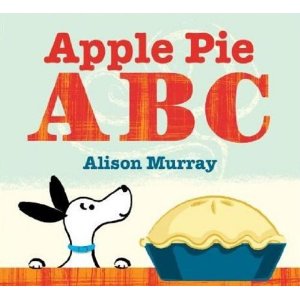 Apple Pie ABC is an alphabet book. It is one of the finest alphabet books I have EVER read. I like it so much because it actually tells a story (with little text) and it calls upon the reader to infer! Alphabet books getting young children to infer! What is not to love?
The premise of the story is simple: an apple pie is placed upon a table. The little pup in the story wants to eat the pie in a bad way, but the little girl in the story knows that he is not supposed to eat it! The author takes the reader through an alphabet journey in the dogs quest to eat the pie. He does everything he can think of to get his paws on it. I love that the author uses a wide vocabulary throughout the book. When sharing this book with your child, be sure to stop and talk about new vocabulary!
Since the text is sparse throughout the story, it is up to the reader to infer (use text clues plus background knowledge) to what the pup and the little girl are feeling and thinking. This is also a great story to work on text-self connections. I think we can all relate to wanting something yummy fresh from the oven!
Have fun reading! I bet you want to bake an apple pie after reading this book!
A few weeks ago, my babies turned one. The babies received a great gift from some great friends: two apple trees and two books about apples. One of the books, Apple Pie ABC by Alison Murray, is simply delightful!
The premise of the story is simple: an apple pie is placed upon a table. The little pup in the story wants to eat the pie in a bad way, but the little girl in the story knows that he is not supposed to eat it! The author takes the reader through an alphabet journey in the dogs quest to eat the pie. He does everything he can think of to get his paws on it. I love that the author uses a wide vocabulary throughout the book. When sharing this book with your child, be sure to stop and talk about new vocabulary!
Since the text is sparse throughout the story, it is up to the reader to infer (use text clues plus background knowledge) to what the pup and the little girl are feeling and thinking. This is also a great story to work on text-self connections. I think we can all relate to wanting something yummy fresh from the oven!
Have fun reading! I bet you want to bake an apple pie after reading this book!
Tuesday, September 20, 2011
Grandpa Green
Last week as I was perusing the bookstore, I stumbled across a precious children's book. Grandpa Green by Lane Smith is a sweet and sentimental book about family history and love. In this book a little boy shares the events of his Grandpa's life. The story is simple, yet it explores complex topics such as aging, memory loss and the power of family history.
This is a great book for both adults and children. I guarantee it will touch your heart - especially if you have a loved one who has experienced memory loss. It is a great conversation starter to talk to your children about the difficulties of aging.
Because it is a story about family, it is a great book to make text-self connections. As you read the book with your child, relate parts of the story to your child's grandma or grandpa. It would be great to even create your own "Grandpa Green" story with events from your family history.
Grandpa Green is a keeper! It is one that now has a spot on my bookshelf!
This is a great book for both adults and children. I guarantee it will touch your heart - especially if you have a loved one who has experienced memory loss. It is a great conversation starter to talk to your children about the difficulties of aging.
Because it is a story about family, it is a great book to make text-self connections. As you read the book with your child, relate parts of the story to your child's grandma or grandpa. It would be great to even create your own "Grandpa Green" story with events from your family history.
Grandpa Green is a keeper! It is one that now has a spot on my bookshelf!
Thursday, September 8, 2011
The Man Who Walked Between the Towers
After the attacks of September 11 there was a movement to try and explain the events to young children in the format of picture books. The Man Who Walked Between the Towers by Moricai Gerstein is one of those books; however, it does not focus on the fate of the Twin Towers. Rather, it focuses on a time when the Towers brought a sense of wonder to the world!


This is a great book to work on building schema (background knowledge) and creating inferences. Many children have heard of the Twin Towers and know they were destroyed, but many do not know the excitement the Towers created when they were being built. This book provides readers the opportunity to share in the magic of the Twin Towers. This is also a great book for creating inferences. To make an inference, the reader must take his/her own background knowledge and pair it with clues from the text. There are many opportunities in this story to predict what might happen next!
Some questions to guide your thinking conversation:
1. Read the first page of text. Stop and ask your child: How tall do you think the buildings were? Use some landmarks your child might be familiar with to help them understand how tall the Towers were.
2. Read to "Maybe if I dressed as a construction worker..." and ask your child: What do you predict is going to happen next?
3. Read to "Then they carried everything up one hundred and eighty stairs to the roof" and stay to your child: Wow! That is a lot of steps! Do you think you could climb 180 stairs and carry 440 pounds? What does this say about Phillippe?
4. Read to "It was seven-eighths of an inch thick" and ask your child: How big do you think seven-eighths of an inch is? Put your index finger and middle finger together and show you child what an inch looks like? Would you walk on a rope that skinny so high up in the air? How do you think Pillippe feels?
5. Read to "Police Saw it, too." and ask your child: What would you have done if you were there?
6. Read to the end of the story and ask your child: Why do you think the author wrote this book?

The Man Who Walked Between the Towers won the Caldecott Medal in 2004. You know it is a good book when it wins the Caldecott! The story is based on a true event! In 1974 Philippe Petit, a French aerialist, decided he had to tightrope walk between the Twin Towers. He asked the Towers' owners for permission, but he was denied. However, this was not enough to stop him. He disguised himself as a construction worker and climbed his way to the top of the Towers. After reaching the top, he strung wire between the Towers and began his amazing feet!
This is a joyful story about the Twin Towers. Your child will be amazed this is a true story!

This is a great book to work on building schema (background knowledge) and creating inferences. Many children have heard of the Twin Towers and know they were destroyed, but many do not know the excitement the Towers created when they were being built. This book provides readers the opportunity to share in the magic of the Twin Towers. This is also a great book for creating inferences. To make an inference, the reader must take his/her own background knowledge and pair it with clues from the text. There are many opportunities in this story to predict what might happen next!
Some questions to guide your thinking conversation:
1. Read the first page of text. Stop and ask your child: How tall do you think the buildings were? Use some landmarks your child might be familiar with to help them understand how tall the Towers were.
2. Read to "Maybe if I dressed as a construction worker..." and ask your child: What do you predict is going to happen next?
3. Read to "Then they carried everything up one hundred and eighty stairs to the roof" and stay to your child: Wow! That is a lot of steps! Do you think you could climb 180 stairs and carry 440 pounds? What does this say about Phillippe?
4. Read to "It was seven-eighths of an inch thick" and ask your child: How big do you think seven-eighths of an inch is? Put your index finger and middle finger together and show you child what an inch looks like? Would you walk on a rope that skinny so high up in the air? How do you think Pillippe feels?
5. Read to "Police Saw it, too." and ask your child: What would you have done if you were there?
6. Read to the end of the story and ask your child: Why do you think the author wrote this book?
Thursday, September 1, 2011
New York's Bravest
New York's Bravest by Mary Pope Osborne is a story about Mose Humphrey. Who is Mose Humphrey? He is America's first urban folk hero.

During the late 1800's NYC was hit with a string of fires in its' wooden buildings and wharves. The story of Mose, a fictional character, developed from the heroic efforts of all the volunteer firefighters.
As the story goes, Mose was larger than life. He was always the first to a fire and could swim the Hudson in two strokes. Mose always saved the day. However, one day Mose met a fire that burned a hotel to ashes. After that fire, Mose was never seen again. Rumors flew about Moses whereabouts. Was he in Dakota? Mining in California? No. Mose never left NYC. His spirit still lives inside all firefighters.
Mose represents courage and strength of firefighters throughout history. Mary Pope Osborne dedicated her story about Mose to the 343 New York City firefighters who gave their lives to saves other on 9/11. Every time I read this story, I get choked up. Some books, even though meant for children, impact adults on a different level. For me, this is one of those stories!
New York's Bravest helps build background knowledge. Children are able to make text-to-self and text-to-world connections when reading this book.
Questions to start a conversation with your child before reading the story:
Questions to start a conversation with your child after reading the story:

During the late 1800's NYC was hit with a string of fires in its' wooden buildings and wharves. The story of Mose, a fictional character, developed from the heroic efforts of all the volunteer firefighters.
As the story goes, Mose was larger than life. He was always the first to a fire and could swim the Hudson in two strokes. Mose always saved the day. However, one day Mose met a fire that burned a hotel to ashes. After that fire, Mose was never seen again. Rumors flew about Moses whereabouts. Was he in Dakota? Mining in California? No. Mose never left NYC. His spirit still lives inside all firefighters.
Mose represents courage and strength of firefighters throughout history. Mary Pope Osborne dedicated her story about Mose to the 343 New York City firefighters who gave their lives to saves other on 9/11. Every time I read this story, I get choked up. Some books, even though meant for children, impact adults on a different level. For me, this is one of those stories!
New York's Bravest helps build background knowledge. Children are able to make text-to-self and text-to-world connections when reading this book.
Questions to start a conversation with your child before reading the story:
- Discuss the concept of a tall-tale. Who are some of your favorite tall-tale characters? What traits do they have in common?
- What do you think it means to be brave?
- Can you think of a time when you were brave?
Questions to start a conversation during reading.
- As you read, look for traits that make Mose larger than life.
- Read to "they grew silent" and ask your child: Where do you think Mose might be?
- Read to "Truth is, Mose is right here" and ask your child: What do you think the old- timer means?
Questions to start a conversation with your child after reading the story:
- What did Mose do that was brave?
- How are firefighters today like Mose? How are they different?
- Go back and read the Historical Note and Dedication. Why do you think Mary Pope Osborne dedicated this story to the firefighters on 9/11? How did they show bravery?
Sunday, August 28, 2011
September 11th, 2011
This year marks the tenth anniversary of 9/11. It is a day that changed the United States, and the rest of the world, forever. September 11th is now a National Day of Service. The Day of Service was developed to provide a constructive way for individuals to remember and pay tribute to those lost and injured on 9/11. The goal is to help rekindle the sprit of unity that followed after the attacks.
This year, there is an opportunity for teachers and students to pay tribute to all those who lost their lives in the tragic events of that day. The goal is for teachers and students to participate in charitable events and/ or do a good deed. Remember, a good deed can be something simple. It does not have to be elaborate. Scholastic has put together a great set of resources for teachers. It is full of lesson plans and activities discussing the events of 9/11.
The events of 9/11 are not easy to talk about with young children. A great way to share information about the events of 9/11 is through story. Three of my favorite books that help jumpstart conversation about 9/11 are:
The Man Who Walked Between the Towers by Mordicai Gerstein
New York's Bravest by Mary Pope Osborne
Fireboat by Maira Kalman
Throughout the week I will share each book in detail. Until then, go grab your copy!
This year, there is an opportunity for teachers and students to pay tribute to all those who lost their lives in the tragic events of that day. The goal is for teachers and students to participate in charitable events and/ or do a good deed. Remember, a good deed can be something simple. It does not have to be elaborate. Scholastic has put together a great set of resources for teachers. It is full of lesson plans and activities discussing the events of 9/11.
The events of 9/11 are not easy to talk about with young children. A great way to share information about the events of 9/11 is through story. Three of my favorite books that help jumpstart conversation about 9/11 are:
The Man Who Walked Between the Towers by Mordicai Gerstein
New York's Bravest by Mary Pope Osborne
Fireboat by Maira Kalman
Throughout the week I will share each book in detail. Until then, go grab your copy!
Wednesday, August 24, 2011
Hooway For Wodney Wat
Hooway For Wodney Wat by Helen Luster is a heartwarming story that will touch your heart. Rodney Rat is a small rodent who cannot pronounce his r's, so he is known as Wodeny Wat. All of the other rodents in his class constantly tease him. Because of his classmates teasing, Wodney Wat is very shy. He does not like to speak up in class and often tucks his head into his shirt.
One day a big, mean and smart bully named Camilla Capybara comes to school. All of the kids are afraid of her. Poor, shy Wodney Wat saves the day and the class is forever grateful!

One day a big, mean and smart bully named Camilla Capybara comes to school. All of the kids are afraid of her. Poor, shy Wodney Wat saves the day and the class is forever grateful!
This is such a great story to share with your chid as they start back-to-school. It is a great reminder that we are all different and are differences should be appreciated. This book is full of opportunities to make text-to-self connections. At some point, everyone has been the odd man out. Wodney gives readers an opportunity to relate their experiences to his experience. It is also an excellent book to practice inferring. The readers has to use background knowledge plus clues in the text to understand Wodney's feelings.
Some questions to guide your thinking conversation:
1. Read to "Wodney replied miserably" and ask your child: How do you think Wodney feels? Why do you think the other kids pick on him? Have you been teased before? How did you feel?
2. Read to "Was she smarter than any of them" and ask your child: Camilla is a bully. How do you think the kids feel about her? Have you ever met a bully before? How did you feel?
3. Read to " Capybara was the first on the playground, having trampled the others in her path" and ask your child: How would you feel if you were Wodney? What do you predict is going to happen?
4. Read to "The other rodents began to smile" and ask your child: Why are the other kids smiling? Why did Camilla pull up the weeds?
5. Read to" By now Wodney's voice was stronger and his head was entirely out of his jacket" and ask your child: How do you think Wodney is feeling? Why do you think this?
6. Read to the end of the story and ask your child: What lesson do you think the kids in Wodney's class learned? What lesson did you learn?
Tuesday, August 16, 2011
Back-to-School
Can you believe it is time to go back-to-school? I feel like summer just started!
This time of year is super busy. As a parent you are gathering up school supplies, buying new shoes and getting your child back into a bedtime routine. This time of year is just as busy for your child's teacher. Even though your child has yet to step into his classroom, his teacher has been busy preparing for his arrival.
Start the school year off letting your child's teacher know how much you appreciate them. There are a TON of ideas floating around for back-to-school teacher appreciation gifts. Two of my favorites are the calculator gift and the colored pencil vase! I love them because they only take a few minutes to assemble and are inexpensive!

I picked up an oversized calculator and the Dollar Store and put it in a cellophane bag. The cute tag can be found here for you to download! Simple as that! A cute appreciation gift to start the year for the cost of a dollar!

Another great idea is to create a vase out of colored pencils. It might look complicated, but it is really easy!
Directions:

I picked up three packages of 12 colored pencils at Target. Each box cost 97 cents! I was able to create the vase for under three dollars! The bright colors of the vase would make anyone's day!
Happy Back-to-School!
This time of year is super busy. As a parent you are gathering up school supplies, buying new shoes and getting your child back into a bedtime routine. This time of year is just as busy for your child's teacher. Even though your child has yet to step into his classroom, his teacher has been busy preparing for his arrival.
Start the school year off letting your child's teacher know how much you appreciate them. There are a TON of ideas floating around for back-to-school teacher appreciation gifts. Two of my favorites are the calculator gift and the colored pencil vase! I love them because they only take a few minutes to assemble and are inexpensive!

I picked up an oversized calculator and the Dollar Store and put it in a cellophane bag. The cute tag can be found here for you to download! Simple as that! A cute appreciation gift to start the year for the cost of a dollar!

Another great idea is to create a vase out of colored pencils. It might look complicated, but it is really easy!
Directions:
- Clean an empty soup can.
- Put a rubber band on the outside of the soup can.
- Slide colored pencils under the rubber band one at a time until the entire can is covered in pencils!
- Tie a pretty ribbon around the rubber band.
- Fill your vase with water and some pretty flowers!

I picked up three packages of 12 colored pencils at Target. Each box cost 97 cents! I was able to create the vase for under three dollars! The bright colors of the vase would make anyone's day!
Happy Back-to-School!
Wednesday, August 10, 2011
Runny Babbit
I love getting lost in a good book, but sometimes there is not enough time in the day! On those days, I encourage you to get lost in a poem! Runny Babbit by Shel Silverstein is one of my all time favorite poetry collections for children. This collection of poetry took Silverstein twenty years to compile and was published several years after his death. If you and your child need a good laugh (and a mental workout), you need to get your hands on Runny Babbit.
 The introductory poem explains the layout of the book:
Way down in the green woods
Where the animals all play,
They do things and they say things
In a different sort of way-
Instead of sayin' "purple hat,"
They all say "hurple pat."
Instead of sayin' "feed the cat,"
They just say "ceed the fat."
So if you say, "Let's bead a rook
That's billy as can se,"
You're talkin' Runny Babbit talk,
Just like mim and he.
Children LOVE these poems! They find it hilarious that the characters speak funny. You will find it hard to read, but you will laugh too. This selection of poetry shows children how fun it can be to play with language. They will want to rearrange the letters and create their own silly poems.
When reading these poems, just have fun with them. See if your child can read it the way it is written and then see if they can put the poem "back-to-normal." Challenge your child to talk Runny Babbit style. It is much harder than you think and it takes a lot of phonetic skills to be able to do so!
Turn off your television, gather your child next to you on the couch and share a laugh or two!
Way down in the green woods
Where the animals all play,
They do things and they say things
In a different sort of way-
Instead of sayin' "purple hat,"
They all say "hurple pat."
Instead of sayin' "feed the cat,"
They just say "ceed the fat."
So if you say, "Let's bead a rook
That's billy as can se,"
You're talkin' Runny Babbit talk,
Just like mim and he.
Children LOVE these poems! They find it hilarious that the characters speak funny. You will find it hard to read, but you will laugh too. This selection of poetry shows children how fun it can be to play with language. They will want to rearrange the letters and create their own silly poems.
When reading these poems, just have fun with them. See if your child can read it the way it is written and then see if they can put the poem "back-to-normal." Challenge your child to talk Runny Babbit style. It is much harder than you think and it takes a lot of phonetic skills to be able to do so!
Turn off your television, gather your child next to you on the couch and share a laugh or two!
Saturday, August 6, 2011
Mysteries of Harris Burdick
As I have shared before, I love Chris Van Allsburg! His stories transport the reader into another world. One of my all times favorites is The Mysteries of Harris Burdick. It is by no means a new book. It was published in 1984, so it has been around for awhile.

The story offers a very important, but fictional, introduction to the reader. As it is told, Harris Burdick wrote fourteen stories with fourteen illustrations. He dropped his illustrations off to a book publisher and was never seen again. The Mysteries of Harris Burdick is a collection of his drawings. Each drawing has a title and a caption. The rest of the story is left to the reader's imagination!

The drawings are erie, magical and beautiful at the same time! As you examine each picture you will begin to tell a story. I promise! You cannot look at the pictures and not help but wonder what the story is behind it. Because of this, The Mysteries of Harris Burdick is a great book to practice the skill of inferring. There is no right or wrong answer - only your child's background knowledge and the illustration clues to weave a story of fantasy.
This book is a great spring board for a writing activity! Look at one of the pictures with your child. Read the title and the caption. Talk about what might be happening in the picture. What could the story be about? After having a solid conversation, let your child write the story he/she thinks belongs with the illustrations.
I bet your child will surprise you with his/her story! When I was teaching, I would get twenty-six completely different stories and I was always amazed with my students' creativity!
Grab this book. I know you and your child will love it!
Stay tuned. In October, fourteen authors are going to tell their tales of The Mysteries of Harris Burdick! I cannot wait!


The story offers a very important, but fictional, introduction to the reader. As it is told, Harris Burdick wrote fourteen stories with fourteen illustrations. He dropped his illustrations off to a book publisher and was never seen again. The Mysteries of Harris Burdick is a collection of his drawings. Each drawing has a title and a caption. The rest of the story is left to the reader's imagination!
The drawings are erie, magical and beautiful at the same time! As you examine each picture you will begin to tell a story. I promise! You cannot look at the pictures and not help but wonder what the story is behind it. Because of this, The Mysteries of Harris Burdick is a great book to practice the skill of inferring. There is no right or wrong answer - only your child's background knowledge and the illustration clues to weave a story of fantasy.
This book is a great spring board for a writing activity! Look at one of the pictures with your child. Read the title and the caption. Talk about what might be happening in the picture. What could the story be about? After having a solid conversation, let your child write the story he/she thinks belongs with the illustrations.
I bet your child will surprise you with his/her story! When I was teaching, I would get twenty-six completely different stories and I was always amazed with my students' creativity!
Grab this book. I know you and your child will love it!
Stay tuned. In October, fourteen authors are going to tell their tales of The Mysteries of Harris Burdick! I cannot wait!

Friday, July 29, 2011
Where in the Wild?
Where in the Wild? by David Schwartz and Yael Schy has to be one of the coolest books I have come across in a long while! I just know your child will love this book.


Where in the Wild is jam packed with learning. It combines thought provoking poetry, beautiful photography and easy to read non-fiction text about ten different animals. The poems offers context clues about the identity of each animal as well as it's location in the picture. The animals are camouflaged on the corresponding page. When you think you have spotted an animal, just lift the page. The animal is highlighted against the photo's background. Well written informational text is provided for each animal.
This book is great because you cannot read it without creating inferences. The context clues within the poems, plus your child's background knowledge will help your chid infer the name of the hidden animal. Your child will love guessing what animal the authors are describing.
When you read this book to your child, I suggest you cover up the photo while you are reading the poem. Make your child rely on the text and the context clues to try and figure out the name of the animal. After reading and discussing the poem, show your child the picture and see if they can find the camouflaged animal!
Start with the title of the poem. Read it and ask your child: What could this title mean? After reading each poem have your child complete the following stem: My guess is.... or I predict.... Be sure to share your thinking too. You can point out different parts of the poem that offer up clues to the animal's identity.
If you cover up the picture, you can also practice visualizing with your child. The descriptive language used in the poetry is perfect to practice visualizing! Encourage your child to use the following stems when reading the poems: I can imagine.... and I am picturing....
This is also a great book to work on determining importance. When you read the informational text about each animal, you and your child can determine what information you think is important to remember. Have your child complete the following stem after reading about each animal: I want to remember...
I told you this book is jam packed with learning.
Let me know your thoughts on the book!
Monday, July 18, 2011
Press Here
Stop. The. Presses. I found a great book and am so excited to share it with you! Press Here by Herve Tullet is truly a one-of-a kind book. I have never seen anything like it!
On the first page, the reader simply sees a yellow dot. The text instructs the reader to "press here and turn the page." Once you press the yellow dot, you (and your child) will be hooked. Each page instructs you to press, rub, shake, tilt or blow on the page! You will be rewarded with some type of action on the next page! This is truly an interactive book. Who needs an iPad full of apps when you can read Press Here?

On the first page, the reader simply sees a yellow dot. The text instructs the reader to "press here and turn the page." Once you press the yellow dot, you (and your child) will be hooked. Each page instructs you to press, rub, shake, tilt or blow on the page! You will be rewarded with some type of action on the next page! This is truly an interactive book. Who needs an iPad full of apps when you can read Press Here?
Not only is this a fun book, but it also full of teaching and learning. The book is one big set of directions. Read this book with your child and see if they can follow the simple one and two step directions. This is also a great book for making predictions. For every action, there is a reaction. Have your child predict (make an educated guess) what is going to happen if they do as the book instructs.
The audience for the book is meant to be pre-school aged children. However, I guarantee you will love it! I could not help but follow the instructions! I think it is an age-less book.
Get your hands on this book and try it out!
Monday, July 11, 2011
Brontorina
Ballerinas and dinosaurs do not have much in common. Or do they?
Brontorina by James Howe* is a cute story about a a dinosaur, Brontorina, who dreams of becoming a ballerina. She works really hard, but Brontorina meets several challenges along the way. She is too big, does not have the proper shoes and her tail gets in the way.

Brontorina by James Howe* is a cute story about a a dinosaur, Brontorina, who dreams of becoming a ballerina. She works really hard, but Brontorina meets several challenges along the way. She is too big, does not have the proper shoes and her tail gets in the way.
This story is a great reminder to hold fast to our dreams and anything is possible. It is one of those great books that provides a fun story, but also teaches the reader a lesson. The book gently teaches acceptance, rejection, individualism and perseverance.
This is a great book for making text-to-self connections. Most children (and adults) can relate to feeling out-of-place. This story can be used as a springboard to start a conversation with your child about how to handle peer pressure and rejection.
The book also provides the opportunity to talk about problem and solution. There is a solution to every problem, but sometimes it takes some creative thinking to come up with a solution!
Some questions to guide your thinking conversation:
1. Before you read the story have your child make a few predictions. What do they think the story is going to be about? What problems might the main character run into in this story?
2. Read to, "I want to dance!" and ask your child: What might the teacher and kids be thinking?
3. Read to, "...Madame Lucille turned her commands to her students" and ask your child: What do you think is going to happen next?
4. Read to, "You could not" and ask your child: How do you think Brontorina feels? How would you feel?
5. Read to, "The problem is that my studio is too small" and ask your child: What do you think the solution might be?
6. Read to the end of the story. Ask your child the following questions:
- What lesson do you think the author wants us to learn?
- Can you think of a time when you did not fit in? How did you handle the situation? Be sure to share a time you did not fit in too!
You will LOVE this story!
*Author of Bunnicula! Another one of my favorite books!
Thursday, July 7, 2011
A Bad Case of Stripes
Today I am sharing an oldie, but a goodie! A Bad Case of Stripes by David Shannon is one of my all time favorite picture books!

Camilla Cream is a young girl who LOVES lima beans. Even though she loves lima beans, she will not eat them because none of her friends like lima beans. Camilla is worried about what other people think about her. She is so worried that on the first day of school she breaks out in a bad case of the stripes! When she breaks out in stripes, she becomes very worried about what people will think of her. Will she find a cure to her bad case of stripes? You will have to read the book to find out!
This is such a great story to share with your child! It is a great way to introduce the concept of peer pressure and the power of just being yourself to younger children. Since the story is about a young girl and the first day of school, children will easily make text-self and text-world connections. Anytime we can connect what is happening in a story to our own lives we have a greater understanding of the story! This is also a great story to practice inferring. The author never comes out and directly states the lesson that Camilla learns in the story. The reader must infer what the lesson is through his/her own background knowledge and the text clues provided by the author.
Some questions to guide your thinking conversation:
1. Read to, "Camilla was always worried about what other people thought of her" and ask your child: Can you think of a time when you worried about what someone thought of you? After your child shares, you can share a time you were worried about what someone thought of you.
2. Read to, "Then she screamed" and ask your child: What do you think happened to make Camilla scream?
3. Read to, "And he went off" and ask your child: What do you predict will happen when Camilla goes to school?
4. Read to, " ...and she broke out in stars" and ask your child: How do you think Camilla feels? How would you feel?
5. Read to, "But the Experts didn't have a clue, much less a cure" and ask your child: What do you think might cure Camilla?
6. Read to, "...but she was still afraid to admit it" and ask your child: Why is Camilla so afraid to admit she likes lima beans?
7. Read to the end of the story and ask your child: What lesson do you think Camilla learned? How can you apply that lesson to your life?
This story is great for kids (and adults) of any age. The message is priceless.
Tuesday, July 5, 2011
The Winner Is....
The winner is comment number two belonging to Lori! Congratulations!
I am excited about the upcoming books on my list to share with everyone! Now that my summer has calmed down a bit, I should be back to posting regularly.
I am excited about the upcoming books on my list to share with everyone! Now that my summer has calmed down a bit, I should be back to posting regularly.
Monday, June 27, 2011
Give Away Time!
A few weeks ago I shared the book Queen of the Falls and today I am excited to be giving away a copy of the book to one of my lucky followers!

All you have to do to enter the giveaway is become a follower of the blog and leave a comment. If you are already a follower, all you have to do is leave a comment. I would love to see my follower number jump, so tell your friends!
The giveaway will end on Monday, July 4th and the winner will be selected using random.org!
All you have to do to enter the giveaway is become a follower of the blog and leave a comment. If you are already a follower, all you have to do is leave a comment. I would love to see my follower number jump, so tell your friends!
The giveaway will end on Monday, July 4th and the winner will be selected using random.org!
Monday, June 20, 2011
Pop! The Invention of Bubble Gum
Does your child love bubble gum? Have you ever thought about how it was invented? Pop! The Invention of Bubble Gum by Meghan McCarthy shares the very interesting story of how bubble gum came to be!


This is such a cute story full of information about bubble gum. Throughout the story you begin to wonder if bubble gum will ever be invented. It was not an easy process! This story is great for asking questions. Readers should always ask questions before reading the story, while they are reading the story and after reading the story. When readers ask questions, it shows they are active in the reading process. Comprehension cannot occur unless the reader interacts with the text.
Before reading activate your child's schema (background knowledge) and to get them thinking about gum:
1. Say the following to your child: What do you know about bubble gum? Let your child answer. Then share what you know about bubble gum.
2. Say the following to your child: I wonder how bubble gum was invented. Let your child share their thoughts and then share yours.
During the story encourage your child to use some of the following thinking stems to ask questions:
- I wonder...
- What if...
- Why...
- How could...
After the story generate some questions you and your child still have about bubble gum. What else would you like to know about bubble gum? Your questions can lead to more learning about bubble gum!
Be sure to read the end pages! There is a ton of interesting facts about bubble gum.
Extension Activity:
This book easily lends itself to a science experiment!
Question: Do all brands of bubble gum create the same size bubble?
You will need:
1. At least three brands of bubble gum
2. Ruler
3. Paper and pencil for recording findings
- Have your child make a hypothesis. Do they think all bubble gums are created equal?
- Have your child chew a piece of bubble gum for thirty chews.
- After chewing thirty times have them blow a bubble.
- Before the bubble breaks, measure the bubble.
- Record how big the bubble is on a recording sheet.
- With the same brand of gum, repeat the process 2 more times (it is best to use a new piece each time).
- Find the average of your three bubbles.
- Complete the entire process again with each brand of bubble gum!
Let me know what you find out!
Saturday, June 18, 2011
Color Camouflage A Spot-It Challenge
Do you want a fun book that will occupy your child's attention for hours? If not for hours, at least for 15 minutes! Go to the library and check-out Color Camouflage A Spot-It Challenge by Sarah L Schuette!

This book is similar to the I Spy books that kids love. This particular book is color camouflaged. For example, there is a green page and all the objects on the page are green. The author lists five or six objects for the reader to spot. Believe me, it is not easy and it is very addictive!
This is a great book for young readers because it teaches visual discrimination to find specific objects set within a busy background. It also helps build vocabulary in the youngest of readers. Do not worry if your child wants to reread the book several times. Through repeated readings, your child will enhance their visual memory skills.
Once you have found everything there is to find in this book, do not worry! It is a series. There are several of them for you to check out!
This book is similar to the I Spy books that kids love. This particular book is color camouflaged. For example, there is a green page and all the objects on the page are green. The author lists five or six objects for the reader to spot. Believe me, it is not easy and it is very addictive!
This is a great book for young readers because it teaches visual discrimination to find specific objects set within a busy background. It also helps build vocabulary in the youngest of readers. Do not worry if your child wants to reread the book several times. Through repeated readings, your child will enhance their visual memory skills.
Once you have found everything there is to find in this book, do not worry! It is a series. There are several of them for you to check out!
Thursday, June 16, 2011
The Secret Box
I love wordless picture books! Wordless books are powerful teaching tools. Since there are no words, the reader has to rely on picture cues to tell the story. The Secret Box by Barbara Lehman is an excellent addition to wordless picture books.

A long time ago, a boy hides a box beneath the floorboards in an attic. Time passes and the the city changes. One day three children find that same hidden box. They open it and find pictures, maps, tickets and a postcard of Seahorse Pier. The kids use the clues to go on an adventure and find Seahorse Pier!
This is a great book to practice metacognition. Metacognition is simply thinking about your thinking. When you read a book, you should always be forming thoughts about what it is you are reading. Do you agree with what the author said? Are you confused? What is going to happen next? When you read a wordless book it is easy to pay attention to your thinking because there are no words to distract you. As you read the pictures, use some of the following sentence stems to help you think about your thinking:
- I'm thinking...
- I'm noticing....
- I'm wondering...
Since there are no words, the reader has to infer what is happening throughout the story. An inference is created when the reader uses background knowledge and text clues to make a prediction. The text clues in a wordless book will come from the illustrations. You cannot read this story without creating inferences! It is impossible! Some sentence stems to use when inferring are below:
- Maybe....
- Perhaps....
- It could be that...
- This could mean...
Each reader who sits down to read The Secret Box will tell a slightly different story! That is the beauty of wordless books!
Subscribe to:
Posts (Atom)